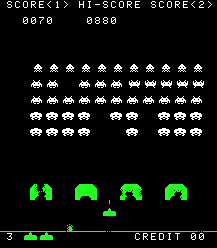
1970s - "Space Invaders" (1978)
Before video games had developed narrative to the extent we have today, the focus was much more on gameplay and competition with others. Arcade-style games were the standard far more than home consoles. Without such strong narratives character had a less prominent role. Space Invaders, one of the best-loved arcade games of all time, had little to no narrative and thus no characters past the player and the aliens. The player, in some ways, was their own character, taking on the hero role in a good-versus-evil struggle, however vague the context.
"The Legend of Zelda"'s Link
Link is a very interesting character to look at in this context because there are so many iterations of him. Unlike the Mario series, where each Mario is assumed to be the same version, each Link (bar a few exceptions) is a new character, and yet in some way the same as each Link before him, which the game explains as a form of reincarnation.
1980s - "The Legend of Zelda" (1986)
The very first Legend of Zelda title very much dropped the player into a strange and unfamiliar world, and expected them to figure it out themselves. Unlike the modern titles, the dungeons could for the most part be tackled whenever the player chose, although later ones would be more difficult without certain items. This went hand in hand with an extremely loose narrative, which in turn saw Link as little more than a piece representing the player; much like other games of its time, the focus was on gameplay over story.
1990s - "A Link to the Past" (1991) and "Ocarina of Time" (1998)
The 1990s marked a 2D to 3D shift for many series, including the Legend of Zelda. From this point on each iteration of Link had a more distinct personality, retaining basic traits but with small variations, much like the games themselves, with the formula and characters not changing a massive amount and each game being sold on a different USP, such as the time shift abilities in Ocarina of Time. The difference in personality could be linked to the release of graphical restrictions; the 3D Link is capable of a much wider range of expression than the pixelated 2D version. This era also developed the story element of the series much further, building on the basics of previous games and providing more of an impetus for the player to complete the story by developing the characters and world, and thus raising the stakes.
2000s - "Majora's Mask" (2000), "Wind Waker" (2002), "Twilight Princess" (2006) and handheld titles
The 2000s were a prolific time for the Zelda series, which continued in its usual fashion and with its standard and very successful formula. Each iteration of Link (or Zelda for that matter) was marked by small design differences - small changes in armour or clothing, a slightly different hair colour or style and a slightly different face or physique. There was also a divergence between Link and 'toon Link,' with the former being older and more serious than his younger counterpart, who made his debut in Wind Waker but arguably continues the legacy (in true Legend of Zelda style) of the smaller Links in older games such as A Link to the Past or even the young link in Ocarina of Time.
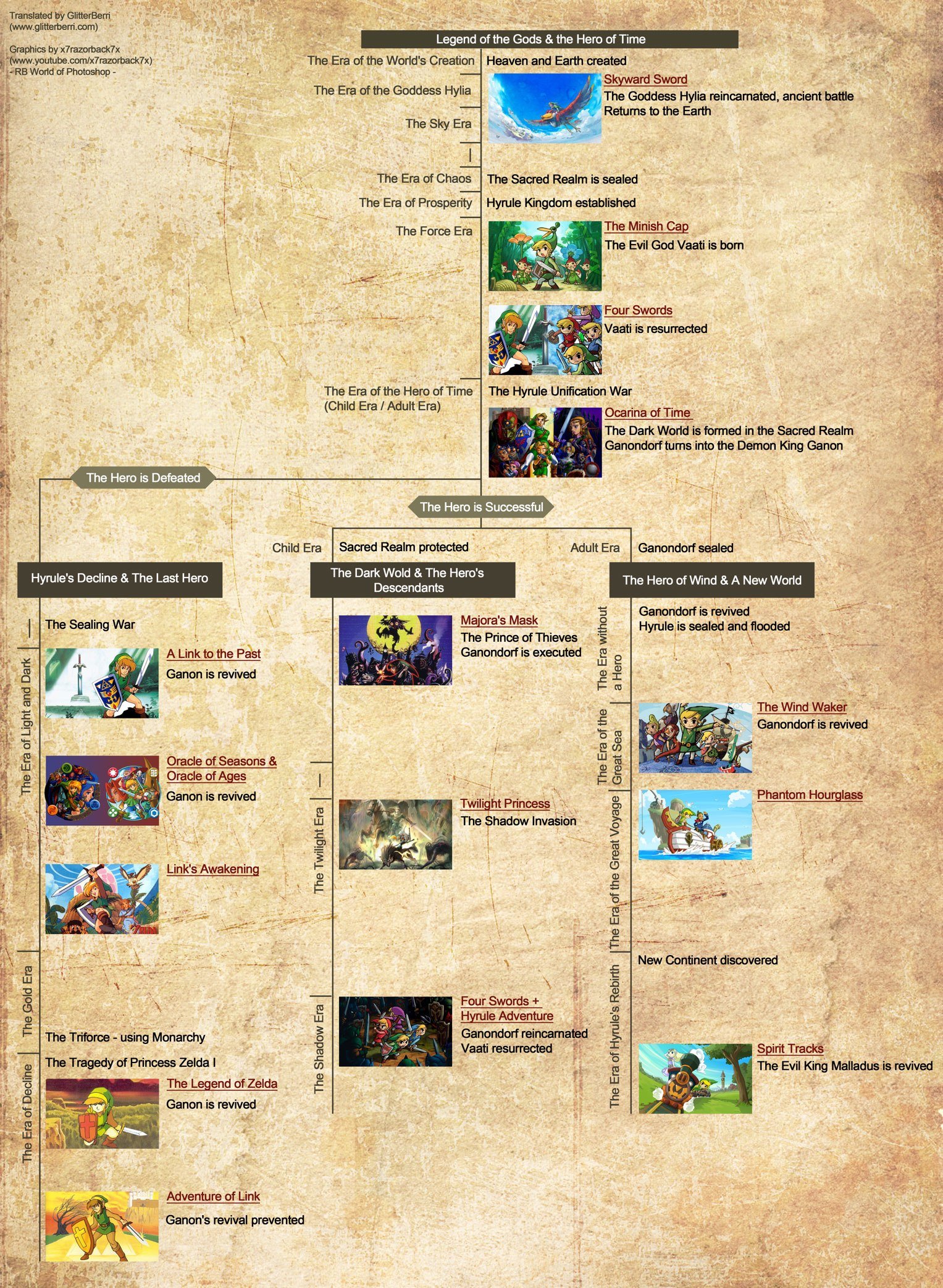
This divergence is easier to explain when the chronology of the Zelda universe is considered, as The Wind Waker, The Phantom Hourglass and Spirit Tracks all take place along the same timeline branch. In fact, the main three iterations of Link (The 'original' Link of A Link to the Past, etc; toon Link; and the Link featured in games such as Ocarina of Time) each largely appear in just one of the series' three main timeline branches. As such, the division could be a good way of defining each of these timelines and establishing continuity between them, as well as individual gameplay styles.
2010s - "Skyward Sword" and "A Link Between Worlds"
As well as remaking old titles for new consoles, Nintendo has very much been returning to its roots when it comes to new titles in the Zelda series in the last few years. Skyward Sword provided the series with a lot of backstory, now being the earliest title with regards to the universe's timeline, and A Link Between Worlds paid very direct homage to A Link to the Past in its world, style and gameplay. Unfortunately this meant very little development as far as the characters are concerned, with neither game providing much variation of the basic Link archetype, and yet both of these games enjoyed a reasonable amount of success. It could be argued that this is because the real strength of the series lies in its worldbuilding, which was particularly well executed in Skyward Sword, meaning that the characters, Link in particular, are just our means of exploring that world, and so do not need very developed personalities - or it could just be that the series is so well-loved by its fans that it can't fail.
Either way Nintendo has developed an undoubtedly successful and iconic series with instantly recognisable characters. While Link does not have the same depth found in other protagonists in modern games, he does have history behind him, and he is also a perfect, malleable avatar for the player to explore with - which is at its core what a game protagonist really is and always has been.

-10.jpg)


.png/revision/latest?cb=20110608172249)


No comments:
Post a Comment