Monday, 26 October 2015

Week summary - 5

Character design: 'The Tinderbox'

When I started this project I had already looked at my time period - Edo Japan - before I read 'The Tinderbox.' This meant that when I was reading it I saw the story in that setting without really thinking about it, and I'm still not sure whether this was helpful of harmful to my creativity.

Initial ideas

Initially, I looked at the soldier character very briefly, because I saw how easily he could be reimagined as a member of the samurai class and how appropriate his forbidden desire to marry the princess would be considering the lack of social mobility in that era. I moved on very quickly, however, as I felt this route was too easy and as a result very unoriginal. I wanted to really push myself on this project and I had too many preconceived ideas for the soldier, so I moved on to a character (the witch) that I had not put as much thought into to force myself to think of fresh ideas.

I also did some more research at this stage into Japanese folklore to find some sources of inspiration to draw from. In particular, three stories caught my attention as being potentially relevant: the yuki-onna (snow-woman), fuchisake-onna (slit-mouthed woman), and the character of Oiwa from the story of Yotsuya Kaidan. The two former stories I had heard of previously, but the latter was unfamiliar to me and I found the idea of disfigurement very interesting in the context of the Tinderbox story.

First round of silhouettes
This time, I tried to be much, much looser with my silhouettes and work smaller to stop myself becoming too precious with them, This method of working is still a strange one for me but I'm starting to see how I can use it to my advantage.

Second round of silhouettes
As with previous projects, I chose the best of each sheet (marked in red) to transfer to the next. This helps me to see what design elements are effective and keep those in mind for the next batch. I also tried out a new method here; instead of working with a solid black shape and sometimes cutting into it, I used a set of spatter brushes mostly at random, and worked over the top with a small white brush. I found this to be a much looser way of working and produced some much more interesting designs than previous methods.

Final silhouette choices
Here I did some further research into the clothing of the era to help give the designs some realism. I spent some time looking at the history of fashion and how it changed during that period, and put together a mood board of images for me to reference (below).
Mood board
 The kimono structure is one thing that I found a little confusing, and even after researching it I am still not entirely sure how the sleeves are constructed. I did however learn a lot of useful information about social conventions to do with clothing and some general rules to follow. I also looked at the costume design in the 2011 film '13 Assassins,' to see how the clothing works in motion.

First round of iterations
Keeping my silhouettes visible, I started work on iterations, borrowing elements from a few designs at a time and combining them. Some designs I dismissed as looking too supernatural or ghostly; I want to keep that element of the character subtle.

I experimented with a few different ways of covering the face - hair, a mask, a travel hat - I like the effect that the hat gives, but will probably do some research into Kabuki and Noh masks to explore the possibilites. I want to make it obvious to the viewer that the clothing, like the witch herself, has seen better days, and make it as creepy as possible without being too extreme.

Monday, 19 October 2015

Week summary - 4

This week covers the rest of the timepiece project.

After choosing one design from the previous sheet which I thought was the most aesthetically balanced I tried to make as many variations of it as I could, sometimes combining two previous designs or taking elements from one design to add to a new one. 


I found choosing a final design from this many versions very difficult, so I shortlisted six of my favourites to help me narrow down my choices, and finally picked one from that list. I chose design number four (see below) as I felt it was not too complex or too simple; it retained much more of the original silhouette than some of the later designs did, while being more visually interesting than the earlier ones.


I made a few final tweaks, and then started on a polished version of the object to use for the model sheet. I noticed that my iterations were a little off-centre and not symmetrical, so I constructed the final design with reference to them rather than painting over one. This process was a little time-consuming in Photoshop using the selection tool and the basic round brush and eraser, and I wonder now if it may have been faster using another programme such as InDesign or even Alchemy.


I made sure to include a scale indicator in my final sheet, as in a lot of the feedback I received people were unsure of the size of the device. In general, I see these timepieces as being variable in size and form, but in this case the piece is fairly large, though still portable.

Final model sheet
When painting my final concept, I wanted to show the kind of people who would be using these devices - scholars and scientists, working in their environment - but keep the timepiece as the focus. I initially had my two scientists on opposite sides of a desk or table, but dropped the idea because I felt having them on the same side felt more collaborative as well as less stale compositionally. Having both characters looking at the object directs the viewer's attention there also, and in my final composition I tried to use the hands to frame the device as well as the characters' faces.


Once I had a layout I was satisfied with I tweaked it a little to make it slightly more in line with the rule of thirds, and painted some values underneath the sketch. I wanted to keep the figures in relative shade compared to the timepiece, which would stand out against them in higher values, and balanced this out with the light source on the left - although the main source is coming from the top right, out of frame. I then overlaid some rough colours. 


Given that the featured piece is gold, I used a complementary purple to set it against in order to make it stand out more. In addition, these colours together, (along with the red I was using in the process shot below) are associated with nobility and royalty, showing the high regard this society has for learning and science. For the final painting, I copied the sketch and used it as a base for me to paint over in a larger document.

Process shot
As I was running out of time, I copied over the piece I made for my model sheet and adjusted the values a little, rather than painting it again in perspective. I would have liked to paint over it, but I felt that I was thinking too much about the details of the piece instead of the overall mood and tone, which is what is important in these pieces.

Final concept piece
Though I may have made some changes in hindsight (for example, populating the background may have made the image feel a little busier), I feel that the final painting showcases the piece really well, although I would like to present it in a group critique to see if my peers and tutors can offer any further advice to improve it. 


References:
https://alladdinmohsin.files.wordpress.com/2011/01/alla057.jpg
http://thumbs.dreamstime.com/z/arabia-window-islamic-architecture-11224795.jpg
http://www.islamiclife.com/userfiles/images/2013/2955_jewellery2.jpg
http://www.zahras.com/ZahrasJewelry/Islamic/ISLM001_L.jpg
https://awalimofstormhold.wordpress.com/tag/jewelry/

Sunday, 11 October 2015

Week Summary - 3


Timepiece project


For this project, I tried to be looser when creating my initial silhouettes to get more variety in my designs. I decided to go for some kind of solar system model, which would be a more futuristic or alternate version of an orrery. For this, I thought the supernova-type shape would be appropriate, but felt I had definitely seen it used before somewhere, although I could not remember where.

I tried to push the shape farther and farther, using the initial silhouette as a starting point. This resulted in some interesting designs, but in the end I felt that the more simple silhouettes (marked in red) were the most effective. I briefly considered a device that would take up an entire room, projecting planets onto the ceiling and walls, but decided that a smaller, more personal object would be much more interesting.


Practicality is something I very much tried to keep in mind when working on these designs and on the previous project. The design, in my opinion, does not need to be completely feasible or able to be constructed in the real world, but it needs to make sense in the context of the world and be believable in that context in order to maintain the player's suspension of disbelief. In this case the setting is potentially futuristic, and draws from periods like the Renaissance and the Islamic Golden Age in its aesthetic and values. I moved forward thinking about how the device would be used, and decided that it would be useful for the user to be able to spin the display around so that they are able to see alignments, locations of planets, etc.


This resulted in two main lines of thought - a gyroscopic device, and one which uses magnetism to suspend the display. After playing with a lot of ideas I decided I found the magnetic device more appealing, because of its slightly more sci-fi look and because it would be easier for the user to see the sphere without the various axes of the gyroscope getting in the way. I want to do a lot more variations on these designs, and start making them much more detailed, with more reference to Islamic design and architecture in particular and its ornate patterns.

Thursday, 8 October 2015

Research: Callois' Classification of Games in Video Games


Making this chart, I had to consider how I'd apply Callois' classifications to modern gaming genres. I decided that Mimicry as a concept, playing at being something else, is fundamental to the RPG genre (and even video games as a whole), in that all RPGs are letting the player pretend to be someone else, somewhere else. Ilinx is an idea which I think goes hand in hand with the horror genre, deliberately scaring or unsettling the player for the thrill. For most games, Agon is also a major element, particularly in player-versus-player combat but also in general when the they are pitted against computer-controlled enemies, effectively in competition against a machine, even if the player is perceiving individual enemies. This also comes into play somewhat with arcade-style games, where the competition would be against others for the highest score. As for Alea, this is less of an element in video games in comparison to traditional card or board games, but can come into play through some AI elements.

When placing these games into the categories, I feel there is some overlap, hence the Venn diagram. Okami and The Legend of Zelda series are games which I feel place more of an emphasis on simulating a world for the player to explore than on the combat or on scaring the player. Telltale's The Walking Dead is similar, but has sequences which deliberately put the player under pressure or aim to scare them, being closer to the horror genre. Dishonored, while still building an amazingly detailed world and allowing the player the role-playing element through its chaos system, focuses more on the skill of the player in achieving victory against enemies than on world exploration. Alien: Isolation is an interesting one, I think, because of its random AI element, presenting the players with a much harder to predict enemy and thus making the game all the more unsettling. 

Tuesday, 6 October 2015

Research: Development of Character in Video Games


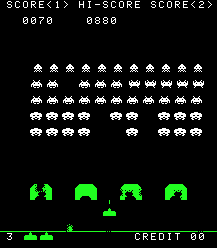
1970s - "Space Invaders" (1978)

(Image source)
Before video games had developed narrative to the extent we have today, the focus was much more on gameplay and competition with others. Arcade-style games were the standard far more than home consoles. Without such strong narratives character had a less prominent role. Space Invaders, one of the best-loved arcade games of all time, had little to no narrative and thus no characters past the player and the aliens. The player, in some ways, was their own character, taking on the hero role in a good-versus-evil struggle, however vague the context.

"The Legend of Zelda"'s Link

Link is a very interesting character to look at in this context because there are so many iterations of him. Unlike the Mario series, where each Mario is assumed to be the same version, each Link (bar a few exceptions) is a new character, and yet in some way the same as each Link before him, which the game explains as a form of reincarnation.

1980s - "The Legend of Zelda" (1986)

(Image source)
The very first Legend of Zelda title very much dropped the player into a strange and unfamiliar world, and expected them to figure it out themselves. Unlike the modern titles, the dungeons could for the most part be tackled whenever the player chose, although later ones would be more difficult without certain items. This went hand in hand with an extremely loose narrative, which in turn saw Link as little more than a piece representing the player; much like other games of its time, the focus was on gameplay over story.

1990s - "A Link to the Past" (1991) and "Ocarina of Time" (1998)

(Image source)
(Image source)
The 1990s marked a 2D to 3D shift for many series, including the Legend of Zelda. From this point on each iteration of Link had a more distinct personality, retaining basic traits but with small variations, much like the games themselves, with the formula and characters not changing a massive amount and each game being sold on a different USP, such as the time shift abilities in Ocarina of Time. The difference in personality could be linked to the release of graphical restrictions; the 3D Link is capable of a much wider range of expression than the pixelated 2D version. This era also developed the story element of the series much further, building on the basics of previous games and providing more of an impetus for the player to complete the story by developing the characters and world, and thus raising the stakes.

2000s - "Majora's Mask" (2000), "Wind Waker" (2002), "Twilight Princess" (2006) and handheld titles

(Image source)
(Image source)
The 2000s were a prolific time for the Zelda series, which continued in its usual fashion and with its standard and very successful formula. Each iteration of Link (or Zelda for that matter) was marked by small design differences - small changes in armour or clothing, a slightly different hair colour or style and a slightly different face or physique. There was also a divergence between Link and 'toon Link,' with the former being older and more serious than his younger counterpart, who made his debut in Wind Waker but arguably continues the legacy (in true Legend of Zelda style) of the smaller Links in older games such as A Link to the Past or even the young link in Ocarina of Time.

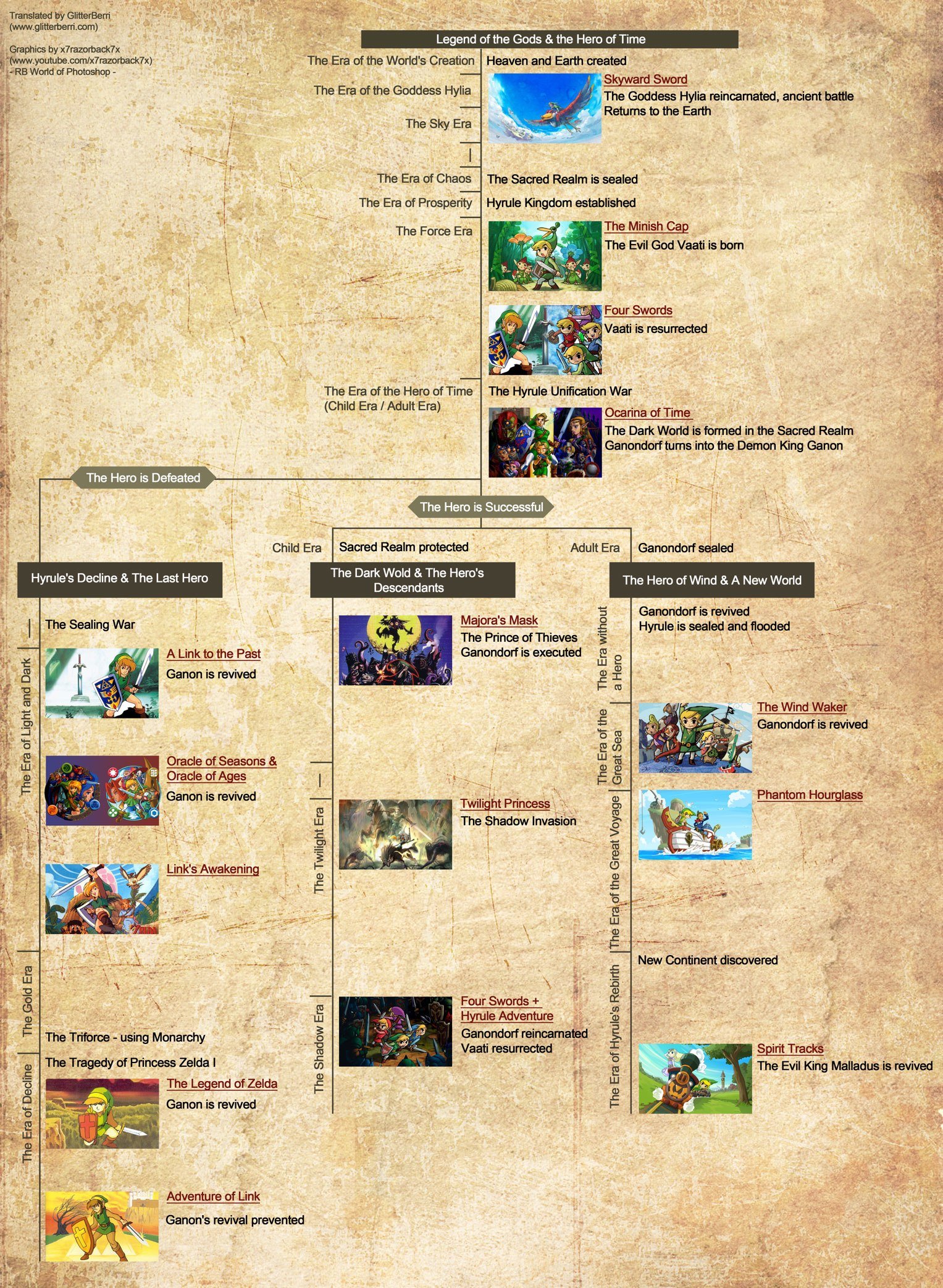
This divergence is easier to explain when the chronology of the Zelda universe is considered, as The Wind Waker, The Phantom Hourglass and Spirit Tracks all take place along the same timeline branch. In fact, the main three iterations of Link (The 'original' Link of A Link to the Past, etc; toon Link; and the Link featured in games such as Ocarina of Time) each largely appear in just one of the series' three main timeline branches. As such, the division could be a good way of defining each of these timelines and establishing continuity between them, as well as individual gameplay styles.


2010s - "Skyward Sword" and "A Link Between Worlds"


(Image source)
(Image source)
As well as remaking old titles for new consoles, Nintendo has very much been returning to its roots when it comes to new titles in the Zelda series in the last few years. Skyward Sword provided the series with a lot of backstory, now being the earliest title with regards to the universe's timeline, and A Link Between Worlds paid very direct homage to A Link to the Past in its world, style and gameplay. Unfortunately this meant very little development as far as the characters are concerned, with neither game providing much variation of the basic Link archetype, and yet both of these games enjoyed a reasonable amount of success. It could be argued that this is because the real strength of the series lies in its worldbuilding, which was particularly well executed in Skyward Sword, meaning that the characters, Link in particular, are just our means of exploring that world, and so do not need very developed personalities - or it could just be that the series is so well-loved by its fans that it can't fail.

Either way Nintendo has developed an  undoubtedly successful and iconic series with instantly recognisable characters. While Link does not have the same depth found in other protagonists in modern games, he does have history behind him, and he is also a perfect, malleable avatar for the player to explore with - which is at its core what a game protagonist really is and always has been.

Sunday, 4 October 2015

Week summary - 2


 Project: Design an insect, week 2

Face studies
This week was mainly a process of refining ideas. After working up to a silhouette I thought was effective, I started working on individual features like these face studies. I also started looking at colour schemes, referencing from actual desert insects, doing some very quick and messy overlays just to get an idea of what kind of colours I could use, before moving on to the character sheet and final concept piece.


Colour schemes


Rough colour ideas

Rough face colouring ideas

For the character sheet, I made sure to include any details and notes I felt might be useful to someone else using this character, as well as a few different poses to reference and a full coloured version of the insect.

Character sheet

As for the painting, I wanted to show off the insect's role as a mount as well as its scale and environment. This meant I needed to incorporate the rider into the composition as well, and I tried to keep in mind that the insect should be the dominant figure while I was thumbnailing, and that it shouldn't be overshadowed by the human figure, as well as other compositional rules.

Thumbnails

I realised that in choosing a desert environment there was a natural amount of blue/orange contrast I could take advantage of, and I tried to have the insect's colour scheme follow those colours, keeping orange-reds on the top half and grey-blues on the bottom. In hindsight, I might have rethought dressing my human characters in white, as the eye is drawn to those very light values instead of the darker ones I used for the insect. Despite that, I think that this works very well to showcase the design and I am pleased with how it turned out, especially considering painted backgrounds are an area I have less experience with.

Final painted concept